Restoring sustainable connection in our fast-paced, AI-optimized worlds.
Type
UDesignathon 2026 @ University of Toronto
Role
UX Researcher, storytelling, personas.
Duration
24 Hours
Team
Jacklyn Chen, James Gao, Isobel Bishop
PROBLEM
How can we create a sustainable future we want to live in, both online and offline?
"As generative AI evolves rapidly, there is an exponential rise in augmented and distorted versions of the real-world. People are becoming more susceptible to AI-generated realities and struggle to distinguish what's real from what's not. To make matters worse, these fake realities are created at great risk to our global water supply and air quality."
SOLUTION
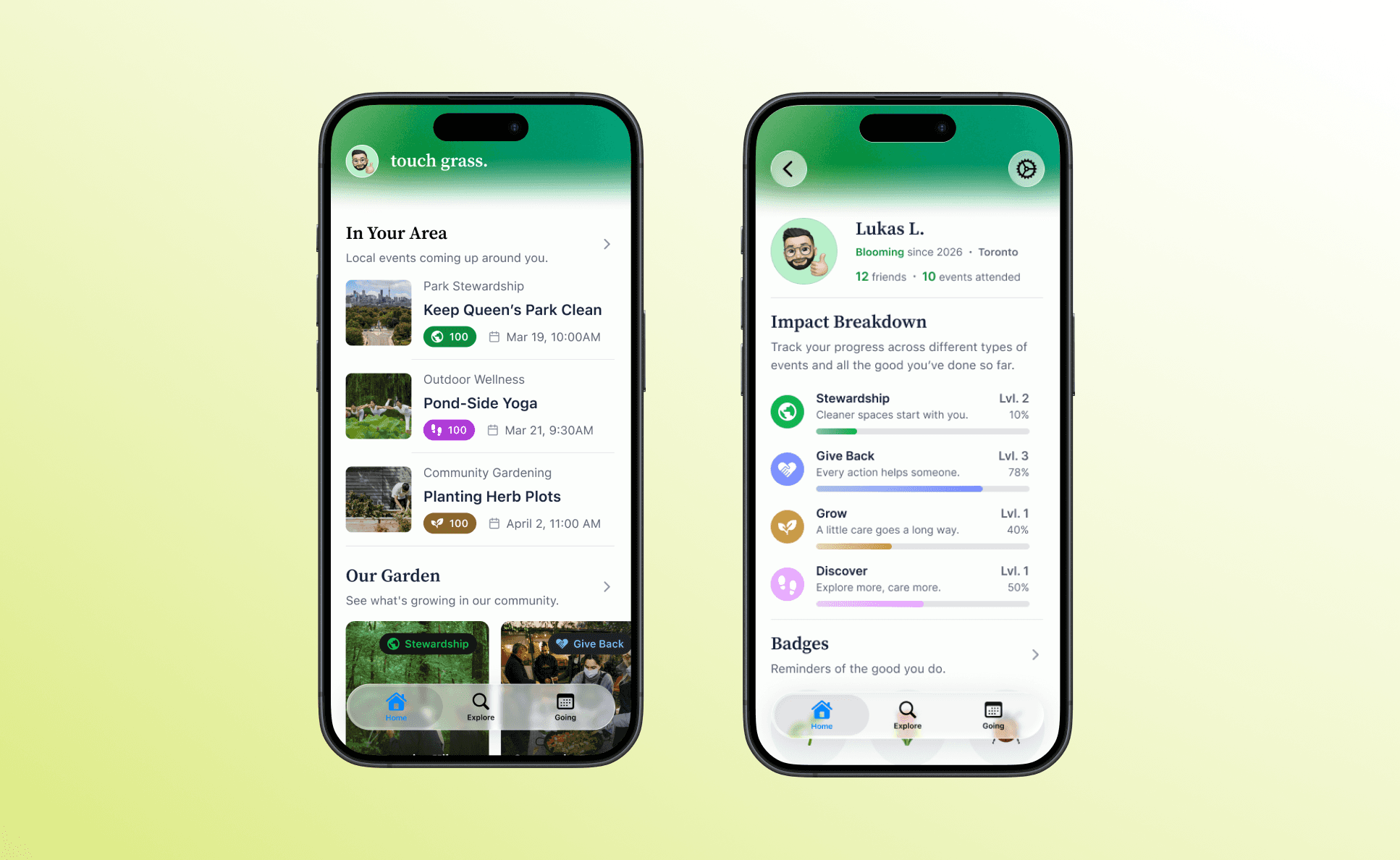
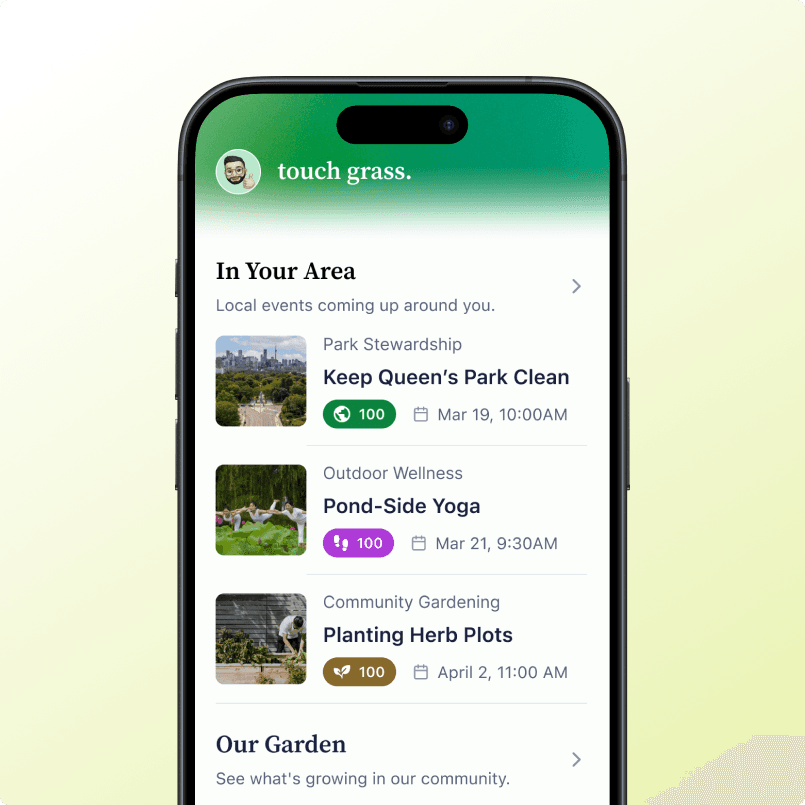
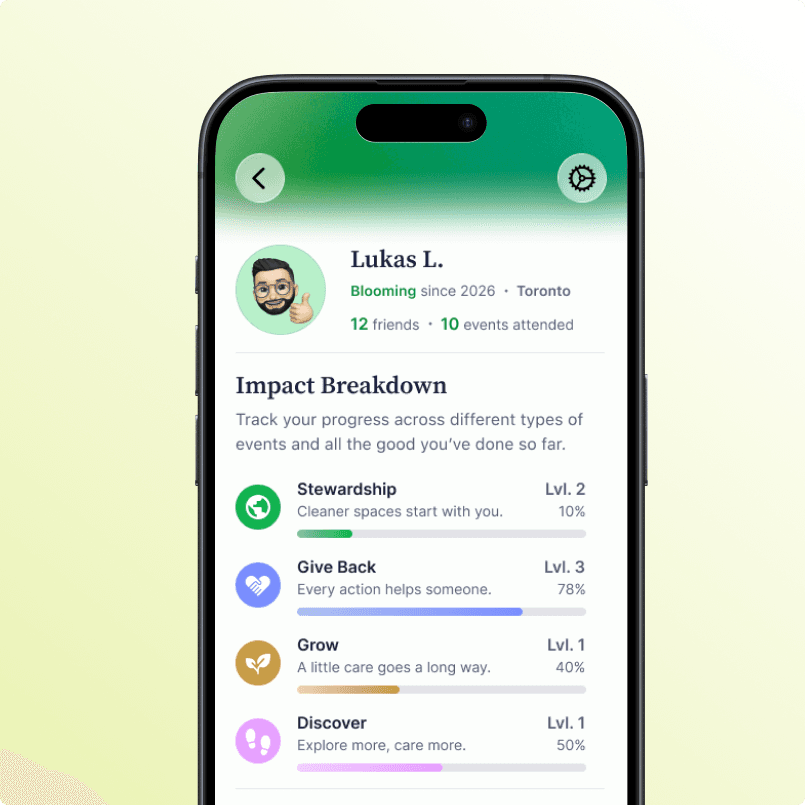
In 24 hours, our team designed an end-to-end, scalable mobile platform connecting users to local sustainability events.
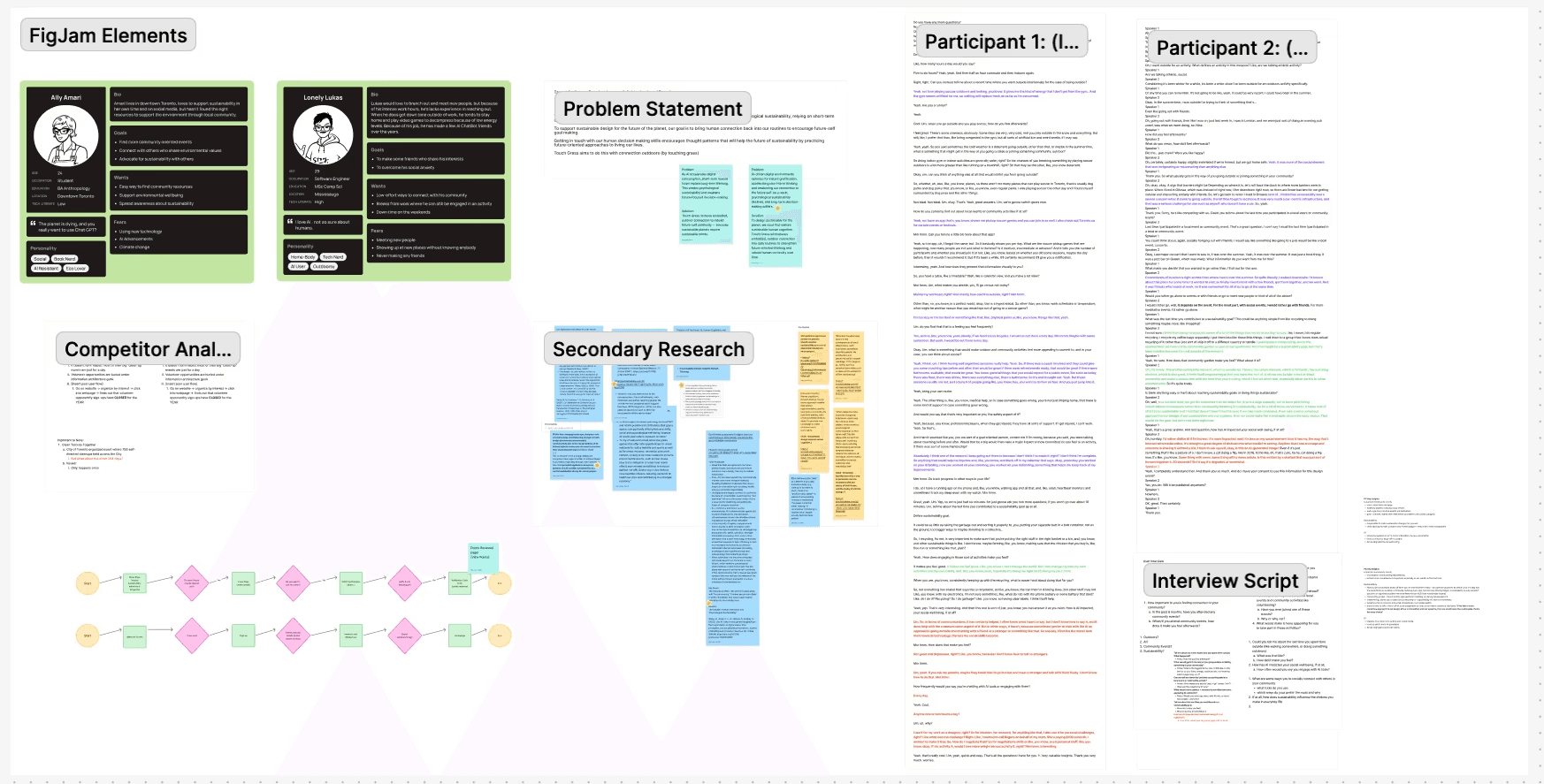
Using insights from secondary research, competitive analyses, and
two user interviews, we brought Touch Grass to life, and presented our minimum viable product to a judge panel.
USER INTERVIEWS
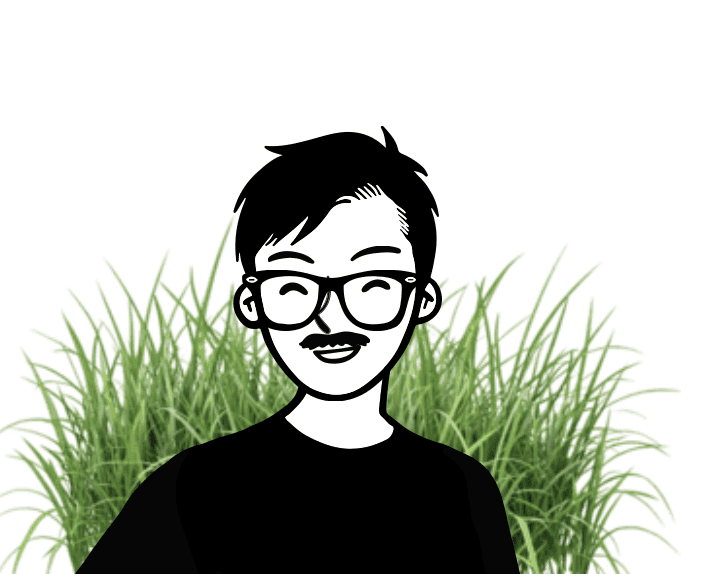
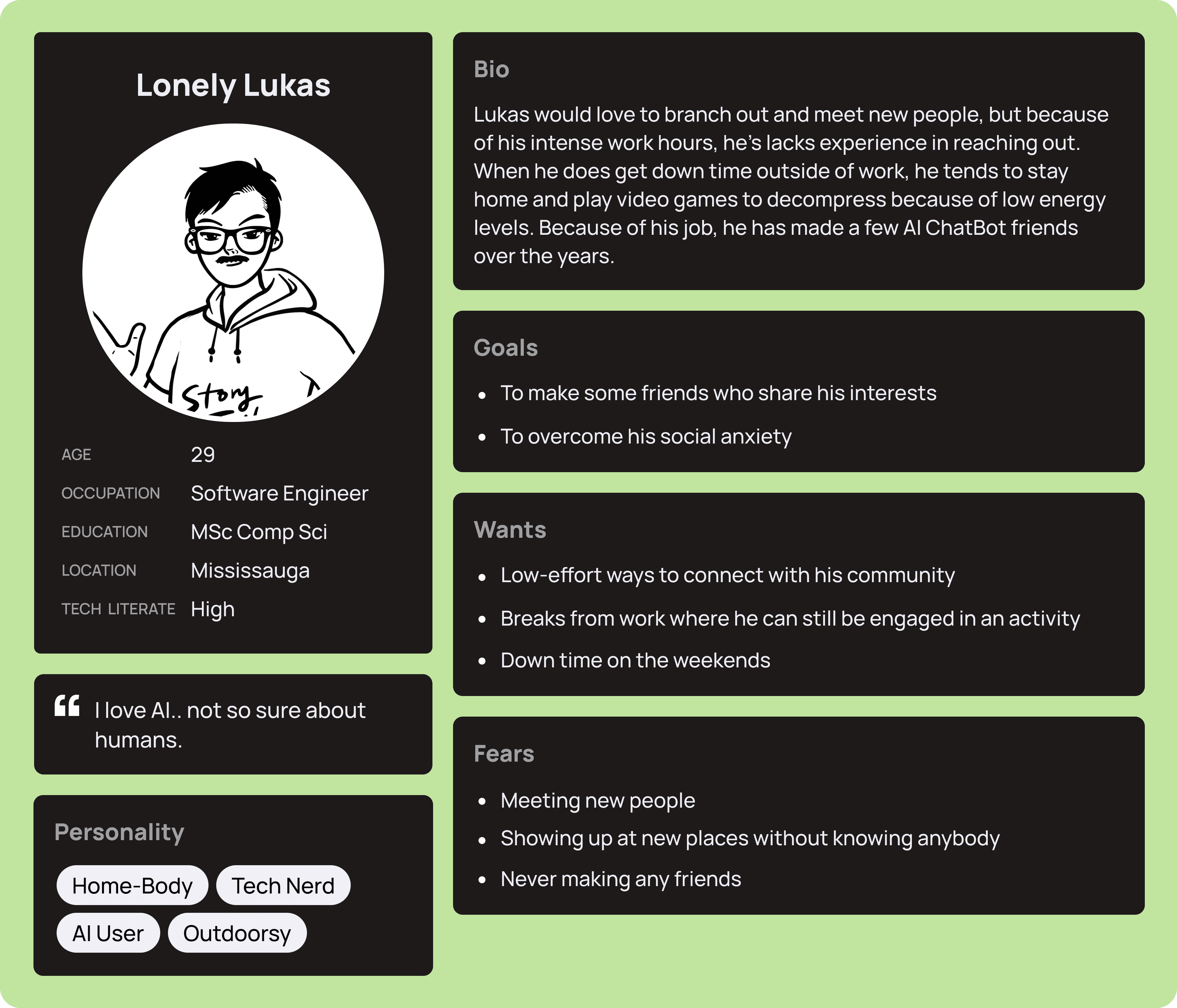
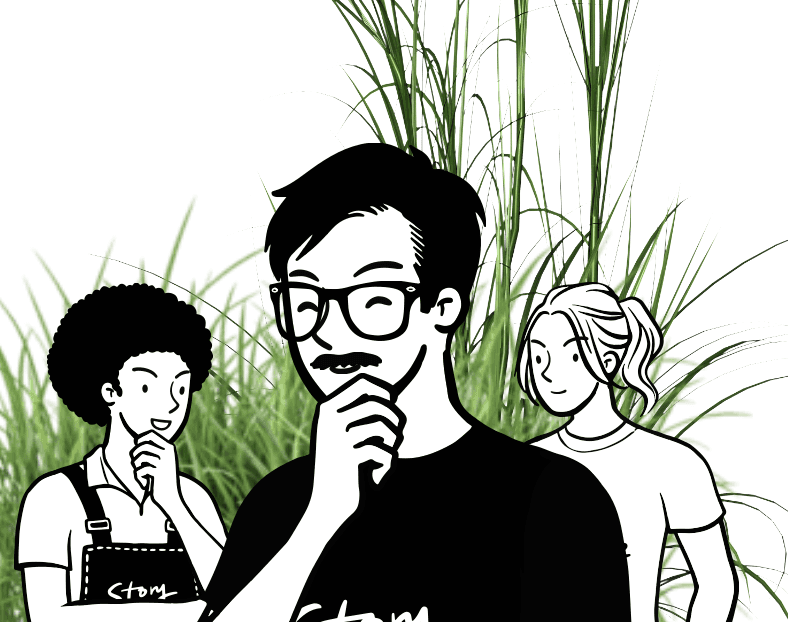
Meet Lukas.
Lukas talks to an AI-bot everyday. But, he hasn't made a new friend in years.
(1) Lukas works in tech, he's busy and engages with AI-chat bots for hours daily. (2) He wants to build community, but currently lacks the skill set. (3) He loves being outside so he's been looking for outdoor activities near him.

"I sometimes prefer to chat with the AI as opposed to going outside and chatting with a stranger …"
– Interview Participant A
AI-overload
Pain point 1 → "Bloom"
Social disconnect
Pain point 2 → "Grow"
Habit building
Paint point 3 → "Flourish"
"…I don't know how to talk to strangers […] If you ask my parents, maybe they knew how to go to a bar and meet a stranger and talk with them freely. I don't know how to do that …"
– Interview Participant A

X Lacks discoverability by burying crucial information in hard-to-find pages.
X Fails to remind users about sign-up dates, causing major friction.

X Busy UIs distract users from the information their searching for.
X Incentivizes information retrieval through paywalls

✓ Effectively focuses on event discovery.
X Sustainability specific events aren't in their own collection, and get hidden behind other events.
“A WHO report on urban planning, environment and health … states that green spaces can positively affect physical activity, social and psychological well‐being, improve air quality and reduce exposure to noise.”
– Urban Green Spaces and Health - WHO Europe, 2016

Design insight
Integrating personal, long-term goals with in-person event attendance and event activities that contribute to point systems became our primary method to retain user engagement. Setting personal goals that are supported by a community-network is how we pushed reconnection, integration, and motivation through Touch Grass.
Design decisions
FAST-PACED ITERATION
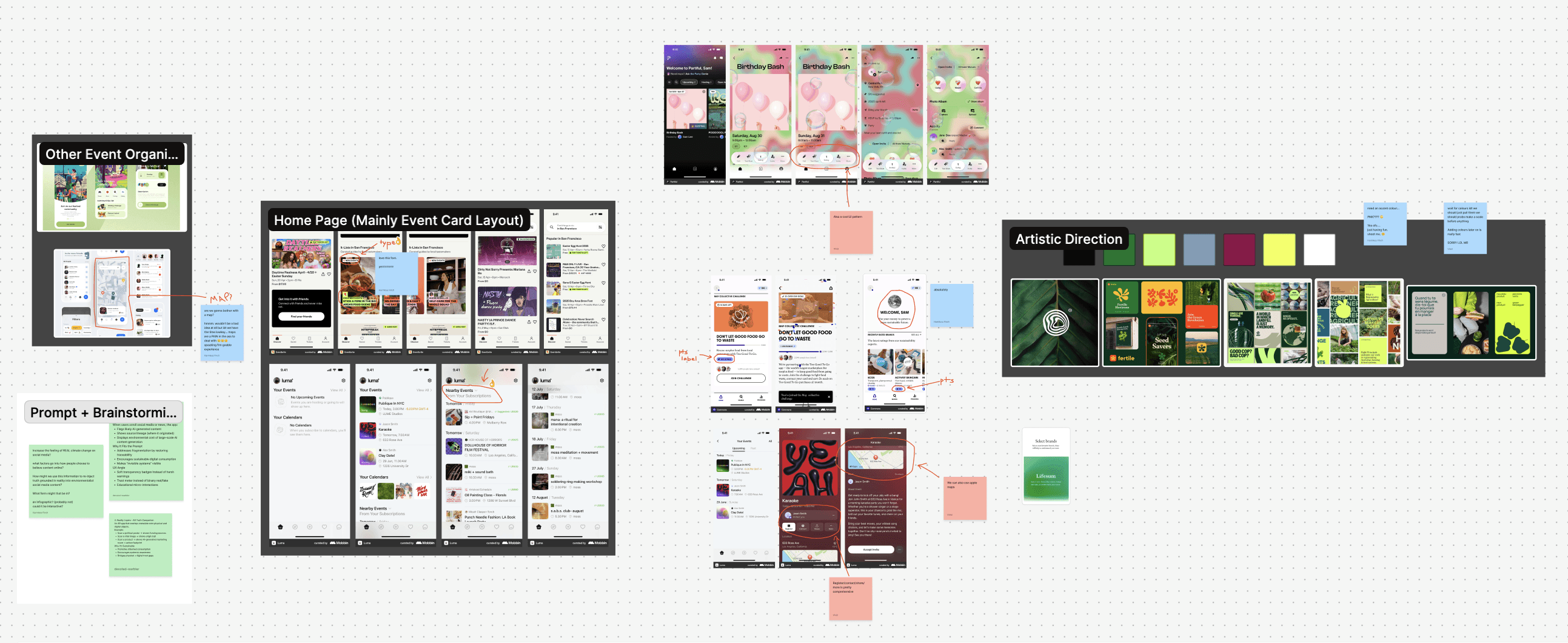
Time was tight. We found inspiration in established design systems.
We studied similar mobile app interfaces and pulled ideas from some specific elements that resonated with the Touch Grass mission.
Final screens
"If we take a more conscious approach to our design of our communities and our systems, then we could make the sustainable choice the easy choice."
– Interview Participant B